

Modular Courses; training in pastoral care and personal development
The course provides experiential learning through small group seminars directed by local tutors and are held throughout the UK. There are four modules in the course and the complete course consists of 120 hours.
The course develops self-awareness, which is essential for effective pastoral work, and also teaches the theory and practice of pastoral care and counselling skills in the context of the Christian faith.
Those who undertake the course are usually people who want to help others and are aware that they need more resources to do so effectively. They may also be those wanting to develop their personal and professional skills, such as pastoral care-givers, counsellors, therapists, clergy, health carers, social workers, teachers and members of befriending organisations.
On completion of each of the four modules a Certificate of Attendance is provided for CPD purposes. You can download a leaflet about the course here.
Available Courses
Courses have recently been held in Winchester, Bolton, Darlington and Rossendale. New courses will be advertised on this page.
More details about the structure and content of the modules are available below.
We also offer tailored training designed to meet the needs of individual organisations in the form of customised short courses.
Customised Short Courses
We can provide short courses tailor-made to meet the needs of your church, organisation or group. These are based on the material we use for our modular Pastoral Care & Counselling course, and can range from a basic Introduction to Listening Skills to more advanced topics such as Understanding Self and Others.
If you are interested in discussing this further, to register your interest in one of these courses, or to be notified when a course is available near you, please contact the office.
Modules
Based on the four concepts of Listening, Understanding, Being and Journeying, both with yourself and others, the course helps participants to develop self-awareness, an essential skill for effective pastoral work, and also teaches the theory and practice of pastoral care and counseling skills in the context of the Christian faith.
Module 1 – Listening to self and others
Module 1 provides an introduction to the principles of pastoral care, faith development using the Dynamic Cycle, a unique psychological and spiritual model. Working In small groups you will have the opportunity to become more self-aware, learning to receive help as well as give it.
Topics include:
- Overview of life and personal stories
- Listening and responding
- Dynamic Cycle
- Pastoral Care
- Journeying and faith development
“Other courses taught me how to change to be more acceptable. This course accepted me as I was and helped me to change.” (Past attendee)
Module 2 – Understanding self and others
In Module 2 you will use the Dynamic Cycle to explore in more detail personal traits and trusting relationships. You will be invited to listen to others’ personal stories and tell your own, helping to promote spiritual and psychological well-being.
Topics include:
- Applying the Dynamic Cycle
- Coping with change
- Counseling skills
- Personality Types
- Psychological defenses
- Depression and links with the past
- Other aspects of pastoral care
“It has been a wonderful journey to freedom.” (Past delegate)
Module 3 – ‘Being’ with self and others
In this module you will be able to explore the development of identity from before birth to the end of life, relating the Dynamic Cycle to each stage of the journey. An important part of the module is the opportunity to reflect on your own experiences, making connections between the past and the present, and listening to those of others. Painting can be a useful tool for exploring your journey.
Topics include:
- Identity stages and selfhood
- Birth and pre-natal experiences
- Childhood and adolescence
- Relationships and sexuality
- Mid life and ageing
- The crises of life
- Meaning and purpose
- Bereavement and dying
- Transitions and spiritual life
“I have learnt that it really is OK to be me, not the me I ought to be, just the me I am.”
(Past delegate)
Module 4 – Journeying with self and others
Module 4 offers more tutored hours of personal development and practice in counseling skills with reflection and meditation. This is an organic process where tutors negotiate the programme with the group according to the needs of its members.
You will be invited to contribute what you have learned from pastoral practice and identify in which areas you need to extend your learning. You will continue to learn more about helping and staying alongside others on their journeys.
There will be more opportunities to increase your self-awareness and growth, building on the dynamics of the group, learning from group members and experiencing peer support.
“I will miss this course dreadfully ‘an oasis of calm, peace and serenity in an otherwise hectic lifestyle.” (Past delegate)
The Dynamic Cycle
In today’s secular cultural climate, people often feel that their worth or significance is directly related to their achievements. This results in a constant struggle to perform better, to achieve more, and when things don’t go well, the feeling of loss of status and rejection.
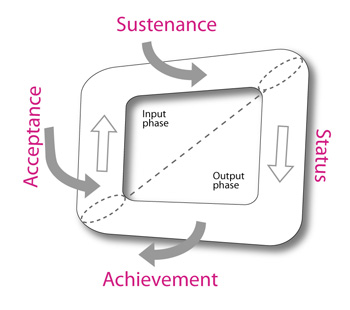
The Dynamic Cycle rejects this hypothesis and begins, not with achievement, but with acceptance: before we can achieve, we need to feel accepted. Acceptance then enables us to be nourished and sustained, and from this arises our sense of status. This solid foundation of acceptance, sustenance, and status then gives rise to achievements that are not based on a need to be accepted, but which come from knowing that we are accepted. This is a foundational hypothesis of the Bridge Pastoral Foundation.
Many difficulties in our personalities and relationships stem from conscious or subconscious feelings about not being accepted and from the insecurity that this generates. A key element of our work is learning to accept each other and, more importantly, ourselves, just as we are.
The Dynamic Cycle is illustrated by the diagram below. To illustrate the cycle further, we also show how the life of Jesus Christ and his relationship of obedience to God the Father models the Dynamic Cycle and enables us to analyse the origins and development of normal, healthy human personality structures and dynamic relationships.
1. Acceptance
Christ’s reponse to dependence as a Son and as man is to pray. (Luke 6:12, 9:28)
He went up into the mountain to pray. He is found alone, praying. (Luke 9:18)
He faces Crucifixion in the Garden praying. He knows that he has constant access. “I knew that you always hear me.” (John 11:42)
He is the only begotten Son of God the Father. This is his Being. John records that “I saw the Splrit come down from Heaven as a dove, and remain on him.” (John 1:32)
2. Sustenance
“As the Father has loved me, so have I loved you.” (John 15 :9)
‘For the Father loves the son and shows him all He does’. (John 5 :20)
Christ is given the Holy Spirit and his gifts – love, joy, peace, patience, glory – all without measure. (John 3:34)
“I am in the Father and the Father is in me.” (John 14:11)
“I and the Father are one.” (John 10:30)
3. Status
“I am God’s Son.” (John 10:36)
“I am not alone.” (John 8:16-18, 29)
He is sent by God, on God’s work. (John 7:18, 28, 29, 33; 6:38)
“I am the light of the world.” (John 9:5, see also 3:19, 8:12)
“I am the living bread that came down from Heaven.” (John 6:51)
Jesus is the water of life. (John 7:37)
‘Full of grace and truth.’ (John 1:14)
Everything is entrusted to him by God. (Matthew 11:27)
The Father is glorified in the Son. (John 14:13)
Jesus said “I say to all of you: In the future you will see the Son of Man sitting at the right hand of of the Mighty One and coming on the clouds of heaven.” (Matthew 26:64)
Jesus commands men to leave all; “take up your cross, follow me.” (John 1:43, 12:26)
4. Achievement
See also John 8:29 and 10:36-7.
He can speak nothing of himself but what he hears from the Father. (John 8:26, 28, 38)
“The words I have spoken to you are are spirit and they are life.” (John 6:63, 8:51)
They are everlasting life to believers. (John 5:24, 40; 14:6)
He is the bread of life, of eternal life, for all who believe on, and eating, partake of him. (John 6:33-35, 48-58)
He is the light of the world, so that those who follow Him do not walk in darkness. (John 8:12, 9:5)
He is to complete the work of redemption God gave him to do. (John 4:34, 16:5, 17:4, 19:30)
“I must work the works of him that sent me, while it is day.” (John 9:4, KJV)